
A good reputation helps your business grow. Local SEO helps people who have never heard of you find that reputation in the first place.
You can do excellent work, take care of your customers, and have a professional website—and still be difficult to find when someone nearby searches for your services. That is why small businesses need SEO: it helps connect what you offer with people actively looking for it.
For a local business, the goal is practical. Help the right people find you, understand whether you can help, and take the next step. Here is where SEO fits, what it can realistically accomplish, and how to decide what deserves your attention first.
What does SEO do for a small business?
Search engine optimization means improving your website so search engines can understand its content and people can find useful answers. Local SEO adds a geographic focus: the services you provide, where you provide them, and the business information customers see in Search and Maps.
For example, someone searching for “move-out cleaning in Richmond” needs different information from someone searching for your company by name. The first person may not know you exist. A useful service page can explain whether you handle empty homes, what the cleaning includes, which areas you cover, and how to request an estimate.
SEO work can include making those pages clearer, improving titles and internal links, resolving indexing problems, and keeping an eligible Google Business Profile accurate. The right priorities depend on the business. Publishing more blog posts will not fix a broken contact form or make an inaccessible service page usable.
Why small businesses need SEO to compete locally
1. Customers search for a service before they know your name
Word of mouth introduces people to your business. Search can introduce your business to people outside that referral network. Someone looking for an electrician, auto repair shop, or cleaning company may start with the problem they need solved rather than a specific provider.
If your website only lists a business name and a few general sentences, it gives that person little help. Clear service information makes it easier to understand what you do and whether you are a good fit.
2. Having a website does not automatically make it discoverable
A website gives you a place to send people. It still needs to be accessible to search engines, organized around your actual services, and useful enough for a visitor to choose a next step.
Consider a remodeling business that offers kitchen and bathroom projects but has only a general “Services” page. A prospective customer may need answers about the specific project, process, and service area. Focused pages can answer those questions when each service warrants its own useful content.
Website optimization looks at both discovery and what happens after someone arrives. A visible phone number, readable mobile layout, and working estimate form matter alongside the search result.
3. Customers need reasons to trust you before they call
Visibility creates an opportunity. The information customers find helps them decide what to do with it. Accurate contact details, genuine customer reviews, relevant project photos, and a clear explanation of your work can help answer the questions people bring to that decision.
These details have different roles. A photo can show the quality of a finished job. A service page can explain what is included. A review can describe another customer's experience. None of them guarantees a sale, but together they give someone more useful information than a vague promise of “the best service.”
4. Search can support your referrals and other marketing
A referral may lead someone to search your business name before contacting you. A social post may prompt them to look at your website. An ad may bring a visitor who wants more detail before requesting a quote.
Keeping your business information clear and current makes those follow-up checks easier. SEO can support the marketing you already do without requiring you to abandon referrals, social media, or paid advertising.
Your website and Google Business Profile have different jobs
Your Google Business Profile helps eligible businesses present information in local Search and Maps. Your website gives you room to explain services, answer detailed questions, and show relevant work. A local SEO plan should consider both.
Google's guidance on local ranking describes three main factors: relevance, distance, and prominence. Accurate information helps Google understand the business, but you cannot edit away the distance between your location and a searcher.
This is why searching from your own office does not tell you how visible you are across an entire service area. Rankings can differ by location and search term. Adding a city to your profile's service areas does not guarantee that you will rank there.
If your profile needs attention, Google Business Profile management can be a focused starting point. Broader local SEO services can also address your website and the gaps between your services and the information customers find.
A real example: map visibility across a service area
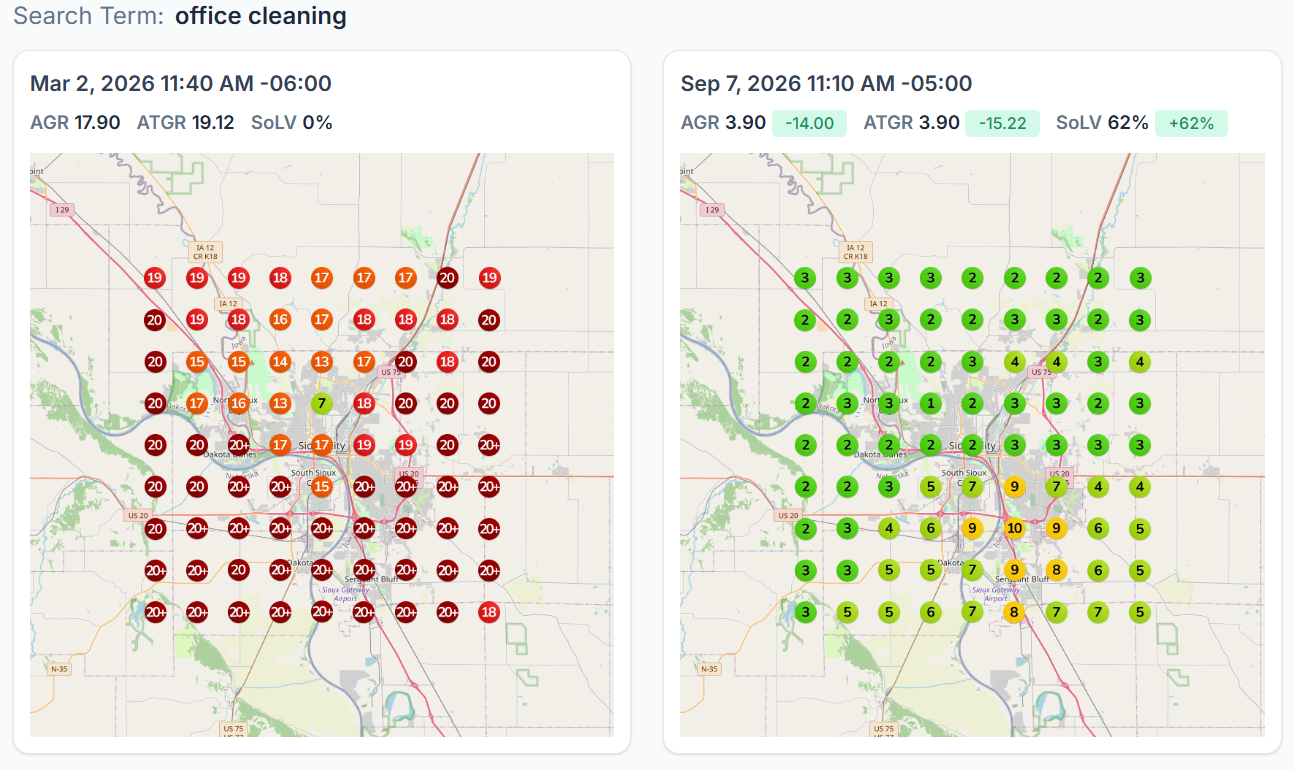
On our local SEO services page, we share an anonymous example of Google Maps ranking scans for “office cleaning.” The reported average rank changed from 17.90 on March 2, 2026, to 3.90 on September 7, 2026. Lower numbers represent stronger positions in those scans.
The useful lesson is how the result is measured. Each point represents a search location, so the scans show more than a single ranking checked from one address. You can see the dated visibility example on our services page.
Those scans document a visibility change for one business and one term. They do not show how many jobs were booked, prove that one particular change caused the improvement, or predict another business's results. That distinction matters when you evaluate an SEO report.
When should SEO become a priority?
Start by asking whether search visibility is part of the problem you need to solve. SEO deserves a closer look when customers search for your services, you can take on more work, and your business is hard to find or evaluate online.
If you need inquiries immediately, SEO may need to sit alongside faster ways of reaching people. If you are already fully booked, the priority may be attracting more suitable inquiries rather than increasing their total number. Your capacity and goals should shape the work.
Some corrections are straightforward to make. Search engines still need time to discover and assess changes, and meaningful progress depends on your starting point, competition, and implementation. No SEO company controls Google's results or can promise a set number of customers.
What should a small business improve first?
Before buying a large content package or chasing every SEO score, work through these checks:
- Confirm your business information. Check your website, Google Business Profile, and important listings for accurate contact details, hours, and services.
- Review your priority service pages. Can a new customer tell what you offer, where you work, and how to request help?
- Check discovery and indexing. Use Google Search Console to investigate whether important pages can appear in search. A page being published does not establish that it is indexed.
- Test the customer journey on your phone. Read the page, tap the phone number, and submit a test inquiry. Confirm that the business receives it.
- Establish a baseline. Record available search, profile, and inquiry data before making changes so later comparisons have context.
A useful SEO plan explains which problem comes first, what will be changed, and how the work will be assessed. It should give you a clearer direction than “we will add more keywords.”
How do you know whether SEO is helping?
Look at the work completed alongside the available results. Google Search Console can help you understand search impressions, clicks, and queries. Business Profile performance can show recorded interactions. Website analytics and lead tracking can add context about what visitors do next.
Keep those measures separate. A website click is not a booked appointment. A phone-button interaction is not proof of a completed call. Ask whether inquiries are relevant, whether customers are in your service area, and whether the business is turning suitable leads into work.
Also compare similar periods and consider seasonality, advertising changes, and business capacity. A report is most helpful when it explains what changed, what remains uncertain, and what deserves attention next.
Common questions about small-business SEO
Do I still need SEO if most customers come from referrals?
It can be useful because referred customers may still check your website, reviews, or business details. Whether you need ongoing support depends on your current visibility, goals, and capacity. An initial review may be enough to identify the immediate priorities.
Can I do SEO myself?
Yes. Business owners can maintain accurate information, improve service explanations, request honest reviews, and learn to use Search Console. Google's SEO Starter Guide is a useful foundation. Professional support can help when the work needs more technical investigation, prioritization, or consistent implementation than you have time to handle.
Do I need to publish a blog every week?
A weekly schedule is not a requirement for useful SEO. First make sure your core pages answer customer questions. Add articles when they contribute a helpful explanation, example, or decision guide that your existing pages do not already provide.
About the author
Melvin Bland is the owner and Local SEO Specialist at Keep Getting Clicks, based in Midlothian, Virginia. He works with businesses across the United States on website optimization, Google Business Profile management, and local search visibility.
Small Business SEO Reading List
Explore the published guides in this series. This list updates as new articles go live.